
White film on dishes: hard water, etching or detergent
A white film on glasses can be one of three things, and each has a different cause.
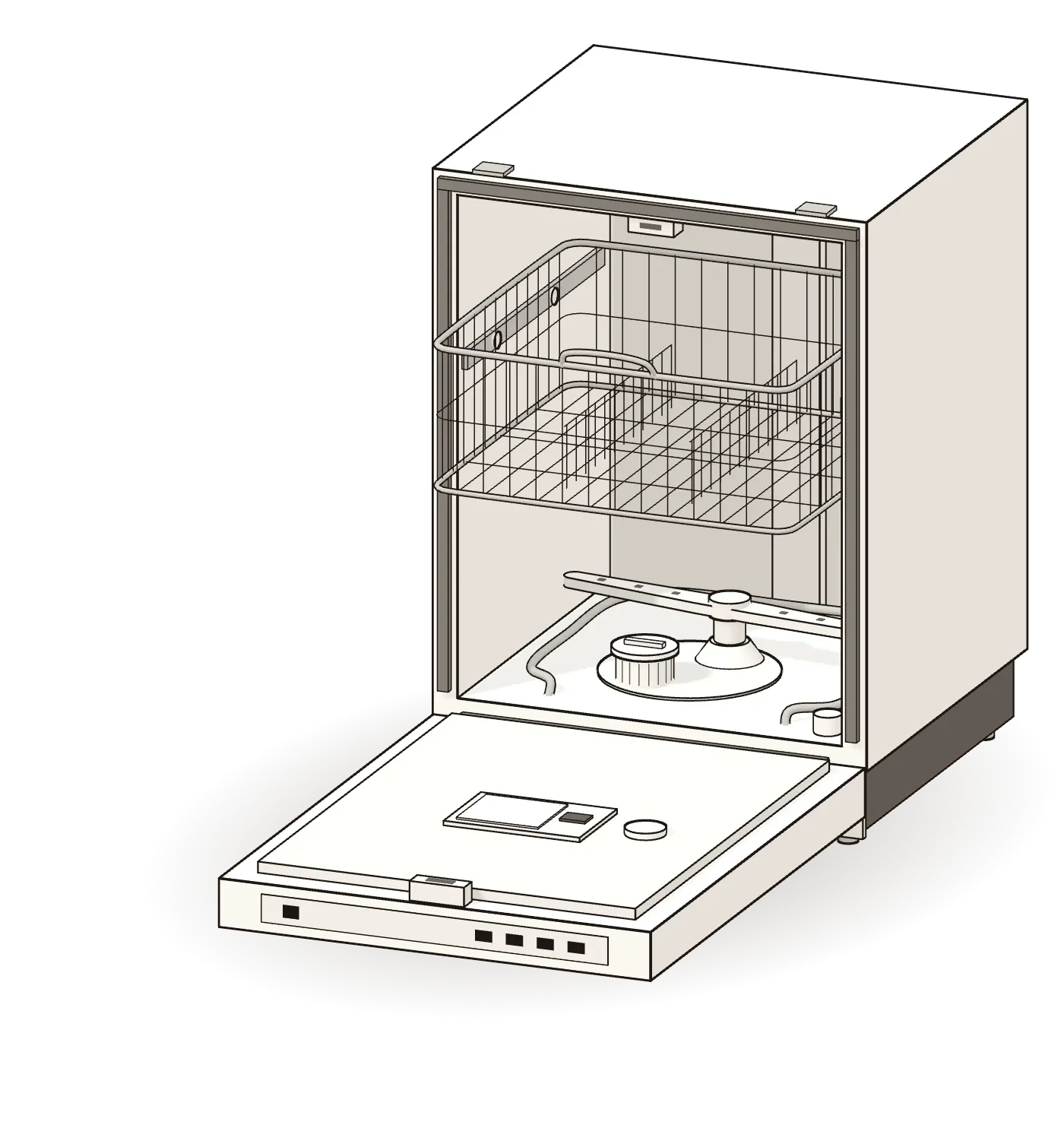
- Door gasket
- Spray arm
- Heating element
- Filter and sump
- Door latch
- Control panel
The film can be minerals or detergent left on the surface, etching of the glass itself, or detergent that never dissolved. Five utilities around Fort Myers, Cape Coral, Bonita Springs and Naples report water that is soft or moderately hard, so hard water is not always the cause. Below is what each film is, what causes it, what the water here actually is, and when the film means the dishwasher itself has a fault.
Three kinds of white film
A film on the surface. Minerals or detergent left behind as the glass dries. Whirlpool traces this kind of film to hard water, too much detergent or poor loading. It sits on the glass, not in it.
Etching. Damage to the glass itself. GE explains that the milky surface cannot be removed because metal ions have been drawn out of the glass, and Whirlpool says a film that does not come off may be etching or a silica film. A glass that has etched stays that way.
Detergent that never dissolved. Detergent caked in the dispenser, or still in the cup after the cycle. This one says less about the water and more about the detergent and the wash itself.
What causes each film
A surface film. Hard water leaves minerals behind, and a detergent dose too heavy for the water leaves a film of its own. Rinse aid is part of the same picture, since it helps the dishes dry and keeps hard water deposits from building up, which is why Whirlpool calls it very important.
Etching. GE puts it down to an over-concentration of detergent granules in the water, or too little water. The usual causes, by GE's and Whirlpool's lists, are too much detergent in soft water, too little in hard water, too little water in the tub, poorly glazed dishes and long, hot cycles, and Whirlpool counts excessively soft water itself among them. Fine glassware and crystal are a case of their own: Miele's manual says that on programs other than its China & Crystal program they may cloud or etch after frequent washing.
Undissolved detergent. Maytag lists the reasons: detergent that has been exposed to air and clumped, a cycle that was interrupted, an item blocking the dispenser door, spray arms that cannot spin freely, and water that is not hot enough. Maytag also notes that detergent keeps best in a cool, dry place, and on a typical Florida summer night the air passes 90 percent relative humidity.
What the water here actually is
Collier County prints this scale in its yearly report: up to 60 mg/L is soft, 61 to 120 moderately hard, 121 to 180 hard, and above 180 very hard. Here is what five utilities in our area report.
| Utility | Hardness it reports | How it treats the water |
|---|---|---|
| City of Fort Myers | about 30 ppm, 1.8 grains per gallon | reverse osmosis |
| City of Cape Coral | 5.5 to 6.5 grains per gallon in 2024 | reverse osmosis, with some raw water blended back |
| Bonita Springs Utilities | 80 to 100 mg/L, 5 to 6 grains per gallon | not stated on its water quality page |
| City of Naples | 58 to 102 mg/L in 2024, average 67 | lime softening |
| Collier County Water-Sewer District | 42 to 94 mg/L in 2024, average 67; 2.4 to 5.5 grains per gallon | nanofiltration, reverse osmosis and lime softening |
Every figure in that table is soft or moderately hard on Collier County's scale, and none comes close to the 15 grains per gallon at which Whirlpool says hard water can damage a dishwasher. So on water like this, a film that will not come off points first to the detergent dose rather than to the water. Every community water system has to send its customers a yearly water quality report by July 1, and Collier County and the City of Naples print hardness in theirs.
On the treatment side, Cape Coral notes that water from reverse osmosis has little or no hardness and that some raw water is blended back in. Collier County runs two plants: the North plant treats with nanofiltration and reverse osmosis, the South plant with lime softening and reverse osmosis.
A dishwasher can also soften its own water. Some Bosch models have a water softening system that runs on special dishwasher salt, and Miele's manual says water above 4 grains per gallon should be softened by the built-in softener, which is programmed to the local hardness and leaves the factory set to 1 grain. Measured against Miele's line, Bonita Springs Utilities water, at 5 to 6 grains, is above it, Fort Myers city water, at 1.8 grains, is below it, and Naples water, at 3.39 to 5.96 grains in 2024, crosses it.
Wells are a different story. Collier County's water district does not serve Golden Gate Estates, where homeowners run their own wells, and a utility's yearly report covers community water systems, not private wells. For a well, only a test of that well gives its hardness.
When the film means a wash fault
Film is a water and detergent matter until the dishwasher stops doing its part. Our dishwasher page counts a washing fault among the causes of a film on glasses, and no change of detergent fixes these:
Food left on the dishes, and detergent still in the cup. The water is not reaching the dishes the way it should, and Maytag ties undissolved detergent to spray arms that cannot spin freely.
A hum with little water moving, and food left on the dishes.
A cycle that stretches for hours, with dishes that come out wet and cold. Maytag lists water that is not hot enough among the reasons detergent does not dissolve.
Too little water in the tub. GE counts too little water as a cause of etching and says to make sure of a proper fill.
Our Dishwasher repair page lists the other symptoms of each fault.
If the film keeps coming back, or you see one of these signs, call or text and we will test the dishwasher in your kitchen.
Bonita Springs and Naples area
Leave these to us
Anything behind the kick plate at the bottom: the wiring there carries household voltage.
The heating element on the floor of the tub.
Pulling a built-in dishwasher out of its opening.
Water on the floor: close the hot water valve under the sink and switch off the breaker.
A burning smell, smoke or a breaker that trips again: switch the breaker off and leave it off.
What our technician checks
We clean out the wash system, check how it washes, and tell you whether the film on your glasses is scale, detergent or a washing fault. When dishes come out cool and wet, we test the heating and the controls that switch it, and when the fill is short, we test the water supply into the dishwasher. You hear the price after the diagnosis, before any work starts. The service call fee is waived when you go ahead with the repair.
We cover Lee and Collier counties around Fort Myers and Bonita Springs, including appliance repair in Cape Coral and appliance repair in Naples.
Questions about white film on dishes
Can etching be undone?
No. GE explains that the milky surface of etched glass cannot be removed, because metal ions have been drawn out of the glass itself. What a visit can still do is find the cause before it reaches the glasses that are still clear.
Is the water here hard?
Mostly not, by the utilities' own figures. The five in the table above report hardness from about 1.8 grains per gallon in Fort Myers up to 6.5 at the top of Cape Coral's range, all soft or moderately hard on Collier County's scale. Private wells are the exception, since their hardness is known only from their own tests.
We are on a well. What changes?
The utility figures do not apply, and only a test of the well gives its hardness. The Florida Department of Health advises testing a private well at least once a year, and more often if the water's taste, odor or color changes. Whirlpool says water at 15 grains per gallon or more can damage a dishwasher, so if a test of your well shows a figure like that, tell us when you call.
Does rinse aid help with etching?
Not more of it. Rinse aid is aimed at the surface film: Whirlpool calls it very important for drying and for keeping hard water deposits from building up. Etching is damage to the glass itself, and its causes lie in the detergent, the water and the cycle.
Glasses still coming out cloudy? Call or text and we will come and find out why.
Bonita Springs and Naples area
Sources
Whirlpool: Etching or cloudy glassware; Spotting or filming on glassware
GE Appliances: Etching on glassware
Maytag: Detergent caked in the dispenser
Collier County: Drinking water quality report 2024; Public utilities master plan summary (2015); Water supply facilities work plan (2019)
Bonita Springs Utilities: Common water quality concerns
City of Naples: Water quality report; Annual water quality report
City of Fort Myers: Water hardness FAQ; Water treatment plant
City of Cape Coral: Water production FAQ
Florida Department of Health: Well water odor and staining
Florida Climate Center: Humidity in Florida
Updated