
Refrigerator not cooling but the freezer is cold
A freezer that still freezes means the refrigerator is still making cold. What has stopped is the air that carries that cold across to the fresh-food section.
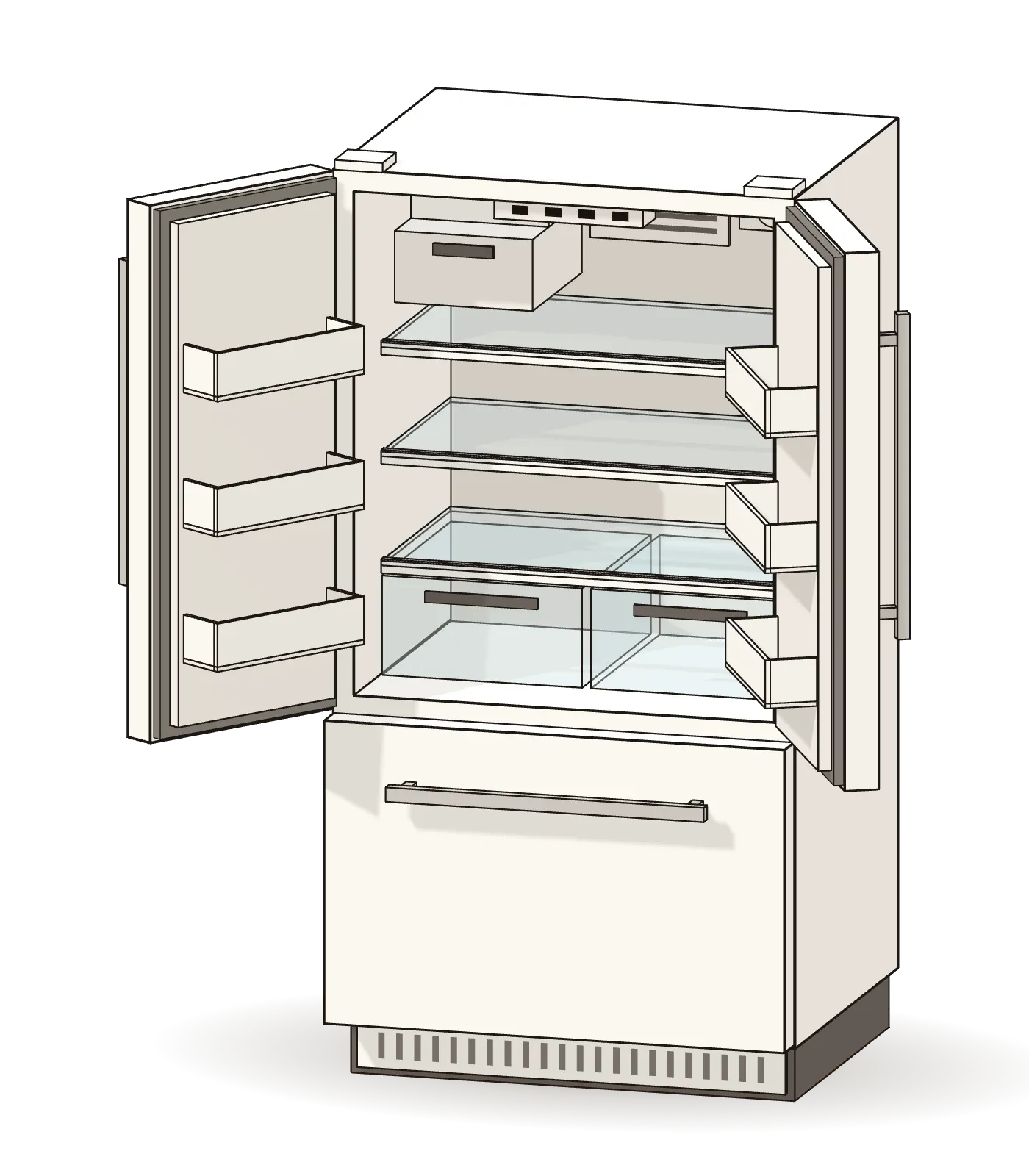
Below is why the air that carries the cold stops, why the humid air here makes it more likely, how to keep the food safe in the meantime, and what our technician does.
How the cold reaches the fresh-food section
On a typical frost-free model, the cold is made in a section at the rear of the freezer and blown through the cabinet. Part of that air stays in the freezer, and part crosses into the fresh-food section; GE's manual describes the freezer control as deciding how much cold air crosses over. So the fresh-food section lives on borrowed air. When that air stops moving, or frost blocks its way, the freezer keeps most of its cold and the other section warms up. Refrigerators with two cooling systems work differently; see the questions at the end.
Signs that point to the fault
The fresh-food section reads above 40°F while the freezer stays frozen. The FDA target for the fresh-food section is 40°F or below. The USDA method for checking it is an appliance thermometer in a glass of water in the middle of the section, read after 5 to 8 hours. Above 40°F, the perishables need a colder place now.
Half an hour of silence is not the fault on its own. GE says most models defrost for about 25 to 45 minutes, usually once or twice a day, with no fan noise and no compressor noise the whole time. A refrigerator that stays quiet far longer, or warms up day after day, is a different matter.
A white layer on the freezer's rear wall, or frost on the vents. On a frost-free refrigerator, frost is supposed to be temporary: GE's timer systems usually defrost every 8 to 15 hours, and LG gives 4 to 16 hours for its own models. Frost that stays means the defrost is no longer clearing it, and frost that keeps building blocks the air. Samsung adds that once frost forms on a vent, it keeps growing until it is cleared.
Frost only around the door opening. That points to a door that no longer seals, which lets in the humid air that turns to frost.
Keep it running until the visit
A running refrigerator shows the technician the fault, while one that has been off for a day can hide it, so keep it running with the doors closed until we arrive. GE asks the same of its owners, so that the symptoms do not disappear before the technician gets there. At room temperature, the bacteria behind foodborne illness can double every 20 minutes, which is why the food comes first.
Still above 40°F, or frost that will not clear? Call or text us, or send the request form, and tell us what you noticed.
Bonita Springs and Naples area
Why humid air matters here
Frost is water that came in from the room. Every time a door opens, warm, humid air comes in, meets the cold, dry air inside and freezes, more so in hot weather. LG, Whirlpool and GE all point to humidity and frequent door openings, and Whirlpool calls humidity a major contributor.
Fort Myers air holds a lot of that moisture. Averages from the National Centers for Environmental Information, published by the Florida Climate Center, put the morning relative humidity in Fort Myers between 84 and 91 percent in every month of the year, highest in September, over a 71-year record; afternoons average 47 to 62 percent. Normal daily highs stay at or above 90°F from June through September. That frost lands where the cold air for the fresh-food section is made, so when the defrost fails, the freezer stays cold while the fresh-food section warms up.
We have found no published failure rate for Southwest Florida and do not quote one. What the manufacturers' own pages show is the chain: humid air in, frost where the cold is made, and a defrost system that has to clear it on every cycle.
Leave these to us
Taking off the freezer's rear panel. What sits behind it includes a heating element and the wiring that feeds it.
Chipping or prying ice. GE warns that a sharp or pointed tool can damage the refrigerating system, and one hole lets the refrigerant out.
Heat guns and hair dryers. Samsung warns that a hair dryer used to speed a defrost will damage the refrigerator.
Testing the electronics or the sensors, and anything on the sealed system.
What our technician checks and fixes
We test the airflow, the defrost system and the controls that run them, and compare the refrigerator's own readings with our thermometer. If ice has built up inside, it has to melt before the repair can be tested, so we clear it and then run a defrost cycle to confirm the repair. On a model with two cooling systems the diagnosis starts on the fresh-food side. We also check how the doors seal, since a door that leaks lets in the humid air that turns to frost.
You hear the price after the diagnosis, before any work starts. The service call fee is waived when you go ahead with the repair.
For the other symptoms we fix, see Refrigerator repair. We work across Lee and Collier counties, around Fort Myers and Bonita Springs, with pages for Refrigerator repair in Cape Coral, Refrigerator repair in Bonita Springs and Refrigerator repair in Naples.
Questions about a warm fresh-food section
I hear sizzling from the freezer. Is something burning?
Usually not. GE explains that a hiss or sizzle during a defrost is water meeting the warm defrost system, and that a red, yellow or orange glow from the freezer is normal while it runs. A burning smell is different: unplug the refrigerator and call.
Can the food in the freezer stay where it is?
Check it first. The USDA method is a thermometer between the frozen packages, read after 5 to 8 hours. If it reads 0°F, the freezer is at the FDA target, and the frozen food can stay. Keep that door shut as much as you can: Samsung's guidance is to open a door for less than a minute at a time, once an hour or less, since the warm air that gets in turns to frost.
My refrigerator has two cooling systems. Does this guide apply?
Partly. On Samsung Twin Cooling models each section has its own cooling, and Sub-Zero built-ins run the two sections on two separate sealed systems. There a warm fresh-food section with a cold freezer points to the fresh-food side's own cooling, so what this guide says about borrowed air does not apply. The frost and the humid air still matter, on the fresh-food side.
Call or text us, or send the request form, with the brand, the model number and what you noticed. It tells the technician where to start.
Bonita Springs and Naples area
Sources
GE Appliances: Top-mount no-frost refrigerator owner's manual; Types of defrost systems; Refrigerator interior moisture
Whirlpool: How to avoid frost build-up
Florida Climate Center: Relative humidity normals
National Weather Service: Fort Myers normals and records
USDA FSIS: Appliance thermometers
Updated