
Wine cooler not cooling
A wine cooler that will not come down to its setting has one of two very different cooling systems behind it, and the first useful question is which one.
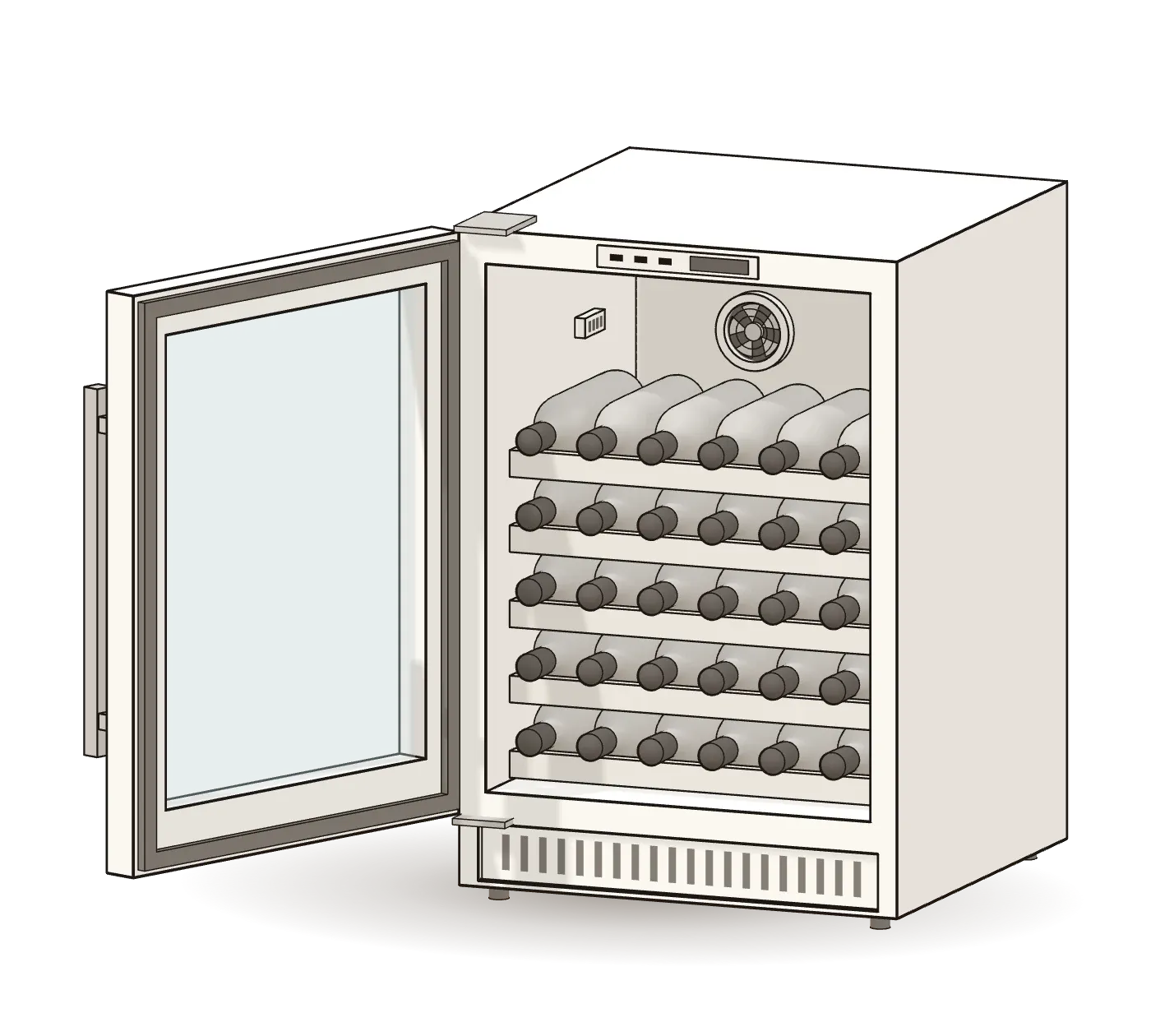
A thermoelectric cooler has no compressor and no refrigerant, and how cold it gets depends on the room around it. A compressor cooler works like a small refrigerator, adapts to changes in room temperature, and has its own failure points. This guide explains how to tell them apart, how warm a room each kind can handle, and when a warm cooler points to the room and when to a fault.
Thermoelectric or compressor: how to tell
Where it sits. Vinotemp makes its thermoelectric coolers with a rear exhaust for freestanding use only, while its compressor coolers with a front exhaust can be set into cabinetry. NewAir draws the same line: a freestanding thermoelectric cooler must never go into cabinetry, and coolers meant to be built in have their ventilation visible on the front. A cooler that came built into the cabinetry is therefore most likely a compressor model. A grille at the bottom front does not settle it on its own, because Whynter's freestanding thermoelectric cooler also breathes through a grille at the bottom front.
How it sounds. In a thermoelectric cooler the only moving parts are small fans, so it is close to silent and almost free of vibration. A compressor cooler sounds like a kitchen refrigerator as its compressor cycles on and off, with the most noise right after the compressor starts and an occasional gurgle of refrigerant.
What the paperwork says. A thermoelectric model may say so in its name, as Whynter's "20 Bottle Thermoelectric Wine Cooler" does. A compressor model's manual may carry a refrigerant warning, such as Danby's "Flammable refrigerant used," since only the compressor type contains refrigerant. Whynter's built-in manual states it outright: the unit is cooled by a compressor that pumps refrigerant.
Why the room decides how cold a thermoelectric cooler gets
A thermoelectric cooler moves heat from the inside to the outside with a small solid-state heat pump. It does not make cold air; it removes heat from the compartment, so it can only get so far below the room: about 20 degrees, by Vinotemp's figure. NewAir wants the room between 50 and 80°F and says that above 80°F the cooler will struggle to hold 55°F. Whynter's thermoelectric manual builds its red and white wine settings on a room at 77°F and says that reaching the set temperature depends on the room's temperature and humidity.
A Southwest Florida summer tests that limit. LCEC, the Lee County Electric Cooperative, notes that many homeowners in Southwest Florida live elsewhere during the summer. For a home left empty with a humidistat set to 65 percent, it suggests 80°F on the thermostat; a plain 83°F setting, which it calls the least efficient method, is only for short or infrequent trips. FPL's advice for a programmable thermostat is 72°F for two hours before sunrise and 88°F for the rest of the day, or 80°F on a thermostat that cannot be programmed and 77°F in a condo or apartment. For an occupied home, LCEC's recommended cooling setting is 78°F.
Vinotemp's figure applied to those settings gives roughly 58°F in a 78°F room, about 63°F in a house at 83°F and near 68°F through an 88°F day. Each of those is above the 55°F that NewAir calls the ideal wine storage level. A thermoelectric cooler that held 55°F all winter and reads 62°F in July may be doing what it was built to do. A cooler that stays well short of that gap is a different case: Whynter lists blocked ventilation, a nearby heat source, the door and its gasket among the reasons a cooler is not cold enough, and beyond those, the cooler itself needs testing.
Compressor coolers have a room range too
Compressor units adapt to changes in room temperature, yet their manuals still give a room range. Whynter's built-in compressor model is meant for a room between 72 and 78°F, and its manual says that above or below that range the cooler's performance may be affected and the inside temperature may swing. Danby notes that the temperature inside its cooler varies with the room, with how often the door is opened and with how many warm bottles were just added. LCEC adds that the heat in an empty home usually makes refrigerators use more energy than in an occupied one. A house held at 88°F through the afternoon is outside the room range Whynter gives for that model.
Room or fault: what the signs point to
Warm right after a restart, a new load or a long door opening. A cooler needs about a day to settle. Sub-Zero judges a unit only once it has run at least 24 hours, Whynter allows up to 24 hours for bottles to reach temperature, and Danby says warm bottles just added change the reading inside.
Warm against the room it stands in. On a thermoelectric cooler, an inside about 20 degrees below the room is the most it can do, by Vinotemp's figure, so a much smaller gap points to how it breathes, to the door and its gasket, or to the cooler itself. A compressor cooler adapts to the room, so in a room inside the range its manual gives, such as Whynter's 72 to 78°F, a warm inside points to the cooler rather than the house. Both readings, the room and the inside, are worth giving us when you call.
Boxed in, or something against it. A freestanding thermoelectric cooler needs open air: Whynter asks for at least 4 inches on each side and 6 inches at the back, and NewAir for at least 5 inches around it. A built-in compressor cooler breathes through its front instead, and Whynter's built-in manual says the air vent there must never be covered or blocked in any way.
Sun on the door, or a range beside it. Heat from outside the cabinet is heat the cooler has to move. Whynter lists a nearby heat source among the reasons its cooler is not cold enough, and both Whynter and Danby want their coolers out of direct sunlight and away from a stove or other heat source.
A click every few minutes and no cooling, on a compressor cooler. GE says a refrigerator compressor can click for 3 to 5 minutes after a power outage while it tries to restart. A click that keeps coming long after that is a fault for us to test, and how often it clicks is worth telling us.
Built-ins with blocked front grilles
A built-in cooler pushes its heat out through the grille on its front, so anything in front of that grille is in the path. Even the cabinet opening matters: Whynter's built-in model asks for a quarter inch at each side and at the top, and Danby's compressor manual says the ventilation openings of a built-in must not be blocked. The opposite case hurts a thermoelectric cooler. NewAir says that a freestanding thermoelectric cooler built into cabinetry lacks ventilation, so its heat pump overheats and burns out, which it calls the number one reason these coolers fail.
On a full-height wine column the machine compartment sits behind a grille at the top or the bottom instead, as our Wine cooler repair page notes. We service these columns too; see appliance repair in Naples and appliance repair in Marco Island.
A cooler moved out to the lanai or into the garage faces normal Fort Myers highs of about 91°F from June through August and 90°F in September, well past the 80°F room NewAir sets for a thermoelectric model. The makers say as much themselves: Whynter says not to install its thermoelectric cooler outdoors, NewAir that thermoelectric coolers are meant for indoor rooms with a controlled temperature, not garages or sheds, and Danby that even its compressor cooler is not designed for anywhere that is not temperature controlled, garages and porches included.
Leave these to us
Anything behind the back panel. On a compressor cooler, the tubing there carries flammable refrigerant that must not be punctured.
Pulling a built-in out of its opening. It sits in its opening with as little as a quarter inch to spare at the sides and the top, so leave it in place for us.
Recharging, or any work on the sealed system. That means refrigerant handling.
What our technician checks
We start with the type, the room and what you noticed, because they split the job in two.
On a thermoelectric cooler we test the cooling system, its power supply and the controls. If everything tests good, the readings show whether the room is the limit.
On a compressor cooler we start where the heat leaves the cabinet, then test the cooling system, the controls and how the door seals. You hear the price after the diagnosis, before any work starts. The service call fee is waived when you go ahead with the repair.
We repair wine coolers across Lee and Collier counties, in the Fort Myers area and the Bonita Springs and Naples area, including appliance repair in Fort Myers and appliance repair in Bonita Springs.
Wine cooler cooling questions
My thermoelectric cooler held 55°F in winter and now reads 63°F. Is it broken?
Not necessarily. Vinotemp puts the limit of its thermoelectric coolers at about 20 degrees below the room, so in a house at 83°F the best such a cooler can do is near 63°F. If the room beside it is close to 20 degrees warmer than the inside, the cooler is working at its limit; a smaller gap is worth a call.
How warm can the room be for a thermoelectric cooler?
NewAir gives 50 to 80°F and expects trouble holding 55°F above that. Whynter bases its wine settings on a room at 77°F.
How long should a wine cooler take to get cold?
About a day. Sub-Zero asks for 24 hours of running before a unit is judged, and Whynter allows up to 24 hours for the bottles to reach temperature.
Cooler still warm after a full day? Call or text the number for your area, or send a request with the brand, the model and, if you have them, the room and inside readings.
Bonita Springs and Naples area
Sources
Vinotemp: Frequently asked questions
NewAir: Thermoelectric wine fridges
Whynter: Thermoelectric wine cooler manual; Built-in wine refrigerator manual
Danby: Wine cooler owner's manual
LCEC: Vacant homes
Sub-Zero: Warm wine unit troubleshooting
GE Appliances: Refrigerator normal sounds
Florida Climate Center: Fort Myers 1991-2020 normals
Updated