
Dryer taking too long to dry? Why the vent run matters
A dryer that needs two cycles is often short of airflow: the hot, damp air cannot leave the house through the vent fast enough.
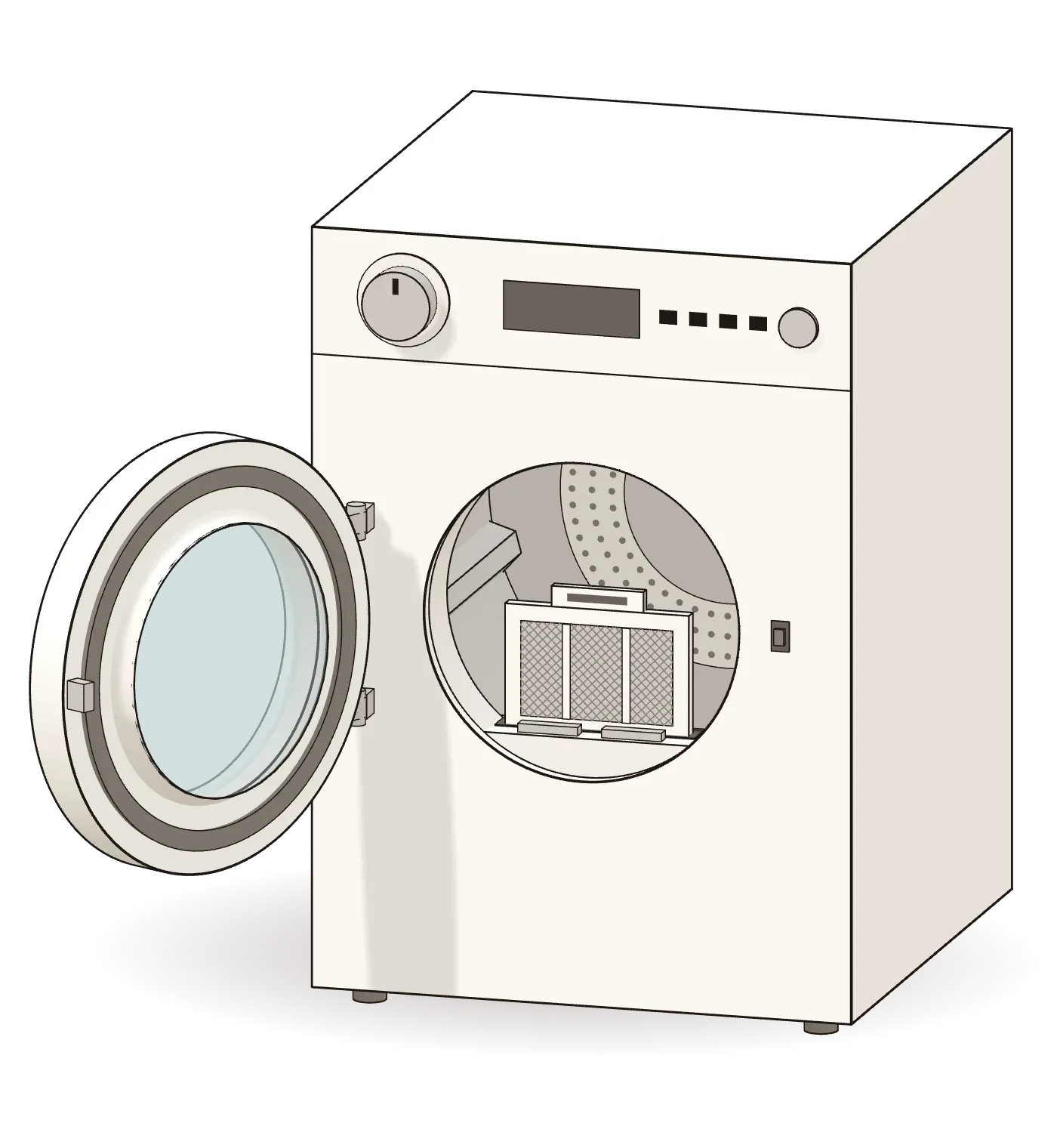
- Control panel
- Drum
- Door seal
- Moisture sensor
- Lint screen
- Door switch
Whirlpool names poor ventilation as a leading cause of long dry times. Below is why the vent run decides how long a load takes, what the code asks of it, what condo buildings add, and why a slow dryer is a fire question. Faults inside the cabinet are on our Dryer repair page.
What "too long" looks like
The Consumer Product Safety Commission says clothes still damp at the end of a typical cycle, or drying that takes longer than normal, may be a sign of a blocked lint screen or exhaust duct. A load that used to dry in one cycle and now needs two is the usual way it shows.
Two causes sit outside the vent. A washer that leaves the clothes too wet makes any dryer slow, and GE says that washer may need service; that belongs on our Washer repair page. And an electric dryer needs both halves of a 240-volt circuit: GE notes that an electric dryer on a 120-volt circuit takes as much as three times longer to dry. Measuring the supply is our part of the job, and we check both legs of it when we come.
Some Whirlpool dryers check the airflow themselves on automatic cycles: during the sensing phase at the start of the cycle, a Check Vent light comes on if a blocked vent or low airflow is detected, and the dryer keeps running anyway.
What the code asks of a vent run
The connector behind the dryer. Florida's code calls it the transition duct and keeps it short and in the open, never inside a wall or ceiling. Pushed back against the wall, a connector can crush or kink and hold the air back.
The length and the bends. Under the code's basic rule, the duct may run 35 feet from the connector to the outside terminal, and every elbow counts against that length. A dryer maker may set a different length for its own models, in the vent chart of its installation instructions, and Whirlpool warns that a run longer than its chart allows shortens the dryer's life and makes drying take longer.
A label near the connection. Where a run's equivalent length is more than 35 feet, the code requires a permanent label or tag within 6 feet of the duct connection. The code allows that longer run only when the limit comes from the dryer maker's installation instructions or from the instructions for a listed power ventilator in the line.
The size and the material. GE allows only 4-inch round duct, because a wider one slows the air and lets lint drop out of it inside the duct. GE also says flexible metal duct, even at the right size, adds drying time compared with solid metal pipe.
Where it ends. The end of the run needs a backdraft damper and no screen, and Whirlpool wants the hood at least 12 inches from the ground or from anything that could block the exhaust, such as flowers, rocks or bushes. GE accepts roof venting but prefers an outside wall.
A fan in the line. For a home's own dryer duct, Florida's code allows only a dryer exhaust duct power ventilator listed to UL 705 and installed to its maker's instructions, and that maker's instructions can then set the run's maximum length.
The Residential volume of the Florida Building Code covers detached houses, duplexes and townhouses up to three stories, and the Mechanical volume carries the same 35-foot limit. These figures are from the 8th Edition (2023); building permits submitted from December 31, 2026, must meet the 9th Edition.
Condo buildings: one shaft, many dryers
In the city of Naples about 60 percent of housing units are in buildings with five or more units, on Marco Island about 56 percent and in Fort Myers about 42 percent, by Census Bureau estimates for 2020 to 2024. On Marco Island 44 percent are in buildings with 20 units or more. Our Appliance repair in Naples and Appliance repair in Marco Island pages explain how a visit works with a service elevator and association rules.
Where one duct system carries the exhaust of dryers on several floors, the Mechanical volume of the code sets how it has to be built. The exhaust fan has to run all the time on a standby power source, and its operation has to be monitored at an approved location, with a sound or light signal when the fan is not running. Dampers are not allowed in that duct, the system may serve clothes dryers only, and the base of the shaft needs a cleanout opening of at least 12 by 12 inches for cleaning and inspection. A building is held to the code in force when its permit was submitted, so a shaft in an older tower may have been built to earlier rules.
A shaft like that carries the exhaust of many units, so when it was last cleaned, whether its fan runs and whether its alarm has gone off bear on every dryer in the building.
Who cleans which part is set by Florida law and by your building's own papers. Under section 718.113 of the Florida Statutes, maintaining the common elements is the association's job, except for limited common elements that the declaration of condominium assigns to the unit owner. When our test shows that the building's run, not the dryer, is holding the load back, we tell you so, and you can take it to the association.
Why a slow dryer is a fire question
For 2008 to 2010 the U.S. Fire Administration estimated 2,900 clothes dryer fires a year in residential buildings, causing 5 deaths and 100 injuries a year, and dust, fiber and lint were the first thing to catch fire in 28 percent of them. In home dryer fires from 2018 to 2020, failure to clean was the leading factor in ignition, at 31 percent. The CPSC describes the chain: lint blocks the flow of air, heat builds up, and in some dryers a fire follows. The U.S. Fire Administration adds that a vent blocked by a nest, or damaged so that it cannot exhaust properly, can overheat the dryer, and a fire may follow.
The National Fire Protection Association asks for the vent pipe to be cleaned once a year, and sooner if clothes start taking longer than normal to dry, and its tip sheet says to turn the dryer off if you leave home or when you go to bed. A load that needs a second cycle is often the first sign that the run is holding heat in.
Leave these to us
A vent that ends on the roof or high on an outside wall: stay off the ladder.
Lint inside the cabinet. The CPSC says a qualified service person should clean the inside of the dryer periodically.
The gas line and connection of a gas dryer, which the NFPA wants inspected by a qualified professional. If you smell gas, leave without touching any switch and call 911 and your gas company from outside.
The building's shared shaft and its fan, which the association maintains where they are common elements.
What our technician checks
We start at the outside end with the dryer running and check the airflow there, which tells us whether the run or the dryer is holding the load back. Then the connector, the path through the cabinet and the joints: the Residential code does not allow ducts joined with screws or similar fasteners, since screws that stick into the duct catch lint. Then the heating, the safety controls that cut the heat when a blocked run overheats the dryer, and the moisture sensing that decides when a cycle ends. If the dryer is fine and the run is the problem, you hear that before any part is replaced, and you hear the price after the diagnosis, before any work starts.
Questions about long vent runs
Is a dryer vent longer than 35 feet against the code?
Not by itself. The code accepts a longer run when the dryer maker's instructions or the maker of a listed power ventilator allow it, and the run must then carry a labeled length near the connection. Longer than the dryer maker's chart allows, though, Whirlpool says the dryer loses performance and takes longer to dry.
Can I put a screen over the outside vent to keep animals out?
No. The code calls for a backdraft damper at the end of a dryer duct and does not allow a screen there. Birds, wasps and lizards move into hoods whose flap is stuck open or missing, so the hood needs fixing rather than covering.
Will a booster fan fix a slow dryer?
Only a dryer exhaust duct power ventilator listed to UL 705 is allowed in Florida; other domestic booster fans are banned. GE does not approve either kind on the vent of one of its dryers. In a shared multistory shaft the code requires the building's own fan to run around the clock, with a signal when it stops, so a slow dryer there is first a question for the association.
If a load takes two cycles, call or text us or leave a request, and tell us how long the vent run is and where it ends.
Bonita Springs and Naples area
Sources
U.S. Fire Administration: Clothes dryer fires in residential buildings; Clothes dryer fire safety; Appliance and electrical fire safety
NFPA: Clothes dryer safety
Whirlpool: Dryer not drying or long dry times; AF or Check Vent; How to check venting
GE Appliances: Dryer taking too long to dry; Dryer exhaust ducting
U.S. Department of Energy: Dryer venting (Home Energy, 2003)
Florida Building Code 2023: Mechanical, exhaust systems; Residential, exhaust systems; Residential, scope
Hillsborough County: HillsGovHub
U.S. Census Bureau: Units in structure, American Community Survey
Florida Statutes: Section 718.113, condominium maintenance
Peoples Gas: If you smell gas
Updated