
Freezer in the garage not freezing in summer
In a Florida summer, a garage freezer that cannot keep food frozen may be fighting the heat rather than failing. Here is why the garage matters and when to call.
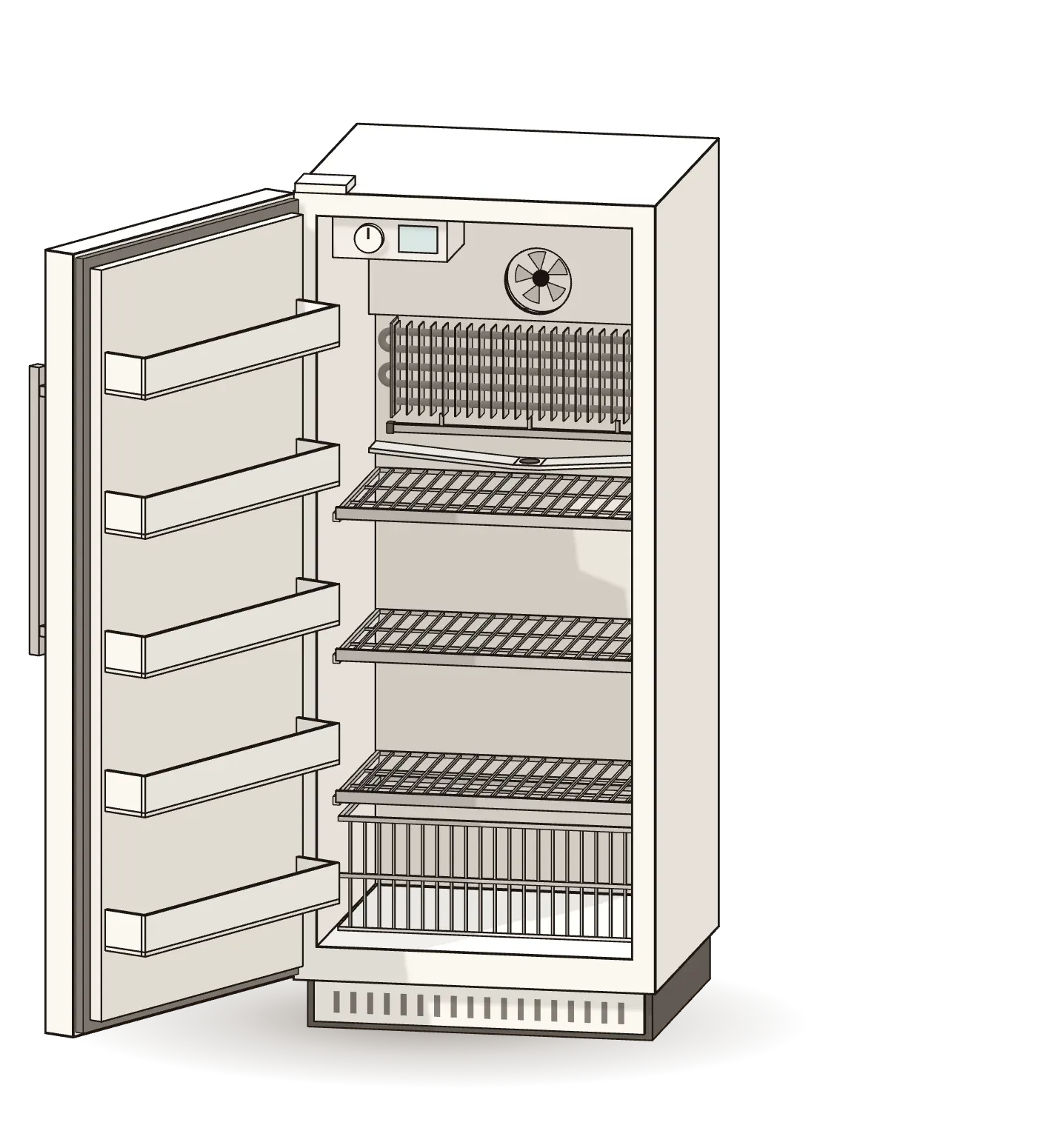
Frigidaire does not recommend a spot that drops below 55°F, and Whirlpool's range starts at 32°F. In Southwest Florida the garage problem runs the other way. Normal highs in Fort Myers stay at or above 90°F from June through September, and the one Florida garage we found measured ran warmer than the air outside nearly all summer. Below is the range of room temperatures a freezer is built for, how a garage here compares with it, how a freezer that is working hard differs from one with a fault, and when to call us.
Here the garage problem is heat
The low end of a freezer's range matters where winters are cold. In Fort Myers, January is the coldest month, with a normal low of 54.3°F. That is far above the 32°F floor on Whirlpool's page and the 0°F floor on GE's, though close to the 55°F that Frigidaire gives.
The top end is the one to watch. Fort Myers normal highs are 89.5°F in May, 91.0°F in June, 91.6°F in July, 91.7°F in August and 90.0°F in September. A garage can run hotter still. The Florida Solar Energy Center monitored the attached garage of a house two blocks from the Atlantic in Cocoa Beach for four summer months. Its temperature was almost always above the outdoor daily temperature, commonly over 90°F, with a mean of 88.1°F and a peak of 99.8°F, against an outdoor peak of 98.6°F. Between 5 and 6 PM the garage averaged over 90°F, and the gap to the outdoor air was widest in the afternoon peak hours. That garage had no ceiling and was open to the attic, it faced west, and it also held the house's air conditioner. The report dates from 1991 and the house sat on the Atlantic coast; we know of no published garage measurement from Lee or Collier County, so it is the closest measured case we found.
So the useful question for a garage freezer here is not whether the garage gets cold, but how close its summer afternoons come to the top of the freezer's own range.
The room range a freezer is built for
Every freezer is built for a range of room temperatures, and the exact range for each model is in its manual. As examples, Whirlpool asks for a spot normally between 32°F and 110°F, GE for a dry, well-ventilated room between 0°F and 110°F, and Frigidaire does not recommend a spot that drops below 55°F.
Liebherr prints a climate class on the serial tag, which sits inside on the left of its freestanding models and outside on the right of its chest freezers. Its examples:
SN: 50°F to 90°F
N: 60°F to 90°F
ST: 60°F to 100°F
T: 60°F to 109°F
A tag that reads SN-T covers the combined span, 50°F to 109°F. A class SN or N freezer reaches its upper limit at 90°F, below the normal daily high in Fort Myers from June through August. A class ST freezer tops out at 100°F, just above the peak in the Florida garage study.
The model number on the label leads to the manual, and it is worth having at hand when you call. On GE upright freezers the label is on the top interior wall toward the rear, on the back of smaller units, or at the bottom right of the freezer compartment face. On GE chest freezers it can be on the outside side or back, on the inside of the lid, or at the top of the inside rear wall. The same plate lists the power ratings.
Why the upper number matters: on its page for garage-ready top-freezer refrigerators, GE explains that above 110°F the compressor oil can overheat and break down, damaging the compressor or the sealed system. More generally, extreme temperatures are hard on a freezer's compressor and can shorten its life.
The garage, not the forecast
What decides the matter is the air right beside the freezer on a hot afternoon, not the forecast for the town, since the Florida garage study found the garage furthest above the outdoor air in the afternoon. Inside, the FDA target for a freezer is 0°F, and the USDA's way of checking it is an appliance thermometer between the frozen packages, read after 5 to 8 hours.
What surrounds the freezer counts as well. Embraco, a compressor maker, writes that a refrigeration system near a stove, against a wall exposed to the sun or in a place without air circulation loses efficiency. A heat source nearby, such as an oven or a radiator, works against a freezer the same way. In a garage that means a west wall that takes the afternoon sun, or a corner where nothing moves the air.
Against the freezer's own range, the same garage can mean different things. A garage that peaks at 96°F is inside a 110°F rating and outside a class N rating: "working hard but within its range" for one freezer, "beyond its range" for another.
Working hard or failing: what the freezer tells you
Runs almost nonstop, food still hard, 0°F inside. In a hot garage this is expected. Frigidaire says a freezer is not as efficient in an uninsulated space without climate control, and that it is normal for it to work longer there. Long running on its own is the price of the heat, not a fault.
Runs nonstop and the reading keeps climbing above 0°F. Frigidaire treats -6°F to 6°F as acceptable on its freezers, so one reading a degree or two above zero is not yet a fault; a reading that keeps climbing is. The freezer is no longer getting rid of its heat, whether the garage is past its range, the air around it is blocked or the cooling system has a fault. Keep the door closed and call.
A click every few minutes, food softening. The compressor is trying to start and cutting out. Garage heat makes it worse, but this is a fault, not only the weather. Keep the door closed and call.
Chest freezer with hot sides. Usually normal. A chest freezer gives off its heat through its outer walls, which GE says can run up to 30°F warmer than the room, and with the compressor off the sides may even feel cool. That is also why GE asks for air clearance on the top and all sides: anything stacked against those walls holds the heat in.
Upright, compressor running, no air moving inside. Heat does not explain this one: the cold is not reaching the shelves. Keep the door closed and call.
Door or lid that does not seal. Warm, damp garage air leaks in, and the compressor runs longer to make up for it; Frigidaire names an open door and a badly fitting gasket among the reasons a freezer runs too much. A seal that no longer closes is a repair. Call us before the food softens.
If the freezer cannot hold 0°F, or clicks and cuts out, call or text us, or send the request form, with the model number and what you noticed.
Bonita Springs and Naples area
Room to breathe: the clearances in the manuals
Whirlpool, chest and upright. At least 3 inches at the top and on both sides, and 2 inches between the back and the wall.
GE uprights. 3 inches on each side, 2 inches at the back and 3 inches at the top.
GE chest freezers. 2 inches on each side and at the back on its current models of 9 cubic feet and up, 3 inches on its 5 and 7 cubic foot models. Its general rule for most models is 3 inches at the top and on all sides, with the owner's manual as the final word. GE also says a freezer should not be installed in a closet.
ENERGY STAR makes the same point in general terms: a few inches between a freezer and the wall or cabinets, for air circulation. In a garage those inches are the first thing to go: shelving, bins, a second refrigerator pushed alongside. A freezer that has just been moved also needs time to settle, since Frigidaire says a newly installed unit may run longer in its first 24 hours while its temperature stabilizes.
Leave these to us
The cover over the compressor at the bottom back. The parts behind it are live while the freezer is plugged in.
Resetting a breaker that trips again right away, or running a freezer that smells burnt. Unplug it and leave it unplugged.
Oil spots under the compressor or a hiss from the tubing. That means a leak, and the refrigerant has to be recovered before the system is recharged.
The rear panel inside a frost-free upright. A heating element sits behind it.
What our technician checks and fixes
We test the cooling system and the controls that run it, compare the freezer's own reading with our thermometer, and check the power at the outlet. If the freezer is boxed in or pushed against a garage wall, we compare the space around it with the clearance its manual asks for. On a frost-free upright we also test the defrost system, and on every freezer we check how the door or lid seals.
You hear the price after the diagnosis, before any work starts. The service call fee is waived when you go ahead with the repair.
For the other freezer symptoms we fix, see Freezer repair. We work across Lee and Collier counties, around Fort Myers and Bonita Springs, including appliance repair in Fort Myers, appliance repair in Cape Coral and appliance repair in Bonita Springs.
Questions about garage freezers in summer
My garage never reaches 110°F. Can heat still be the cause?
It can. A class N or SN freezer is built for rooms up to 90°F. And the Whirlpool and GE pages that give 110°F ask for air clearances in the same instructions. A freezer with storage against its sides, or on a wall in the afternoon sun, does not get the air those pages ask for, and a cooling system in a spot like that loses efficiency.
Should I turn it to the coldest setting for the summer?
No. ENERGY STAR advises keeping a freezer at 0°F, and its consumer guide notes that "max cold" uses more energy; Frigidaire's recommended setting is also 0°F. A freezer that cannot hold 0°F at the recommended setting is either holding its heat in or has a fault, and turning the dial further fixes neither. That is the time to call us.
Where do I find the room range if the manual is gone?
Through the model label. It sits inside near the top rear on many GE uprights and on the lid or the outside of many GE chest freezers, and Liebherr prints the climate class right on the serial tag. With the model number, the maker's support site has the manual; Whirlpool, for one, lets you look it up by model number.
Call or text us, or send the request form, with the brand, the model number and the hottest garage reading you have. That tells the technician where to start.
Bonita Springs and Naples area
Sources
National Weather Service: Fort Myers normals and records
Florida Solar Energy Center: Monitored energy use of a Florida residence (1991)
Whirlpool: Location for chest and upright freezers
GE Appliances: Freezer installation and location; Model and serial number, upright freezers; Model and serial number, chest freezers; Freezer rating plate location; Garage-ready top-freezer models not cooling; Freezer exterior case warm
Frigidaire: Freezer not freezing or not cooling; Freezer runs too much
Liebherr: Refrigerators and freezers FAQ
ENERGY STAR: Freezers; Consumer messaging guide (2015)
USDA FSIS: Appliance thermometers
Updated